(The previous post was off topic, but on the blog. This post is on topic, but posted elsewhere.)

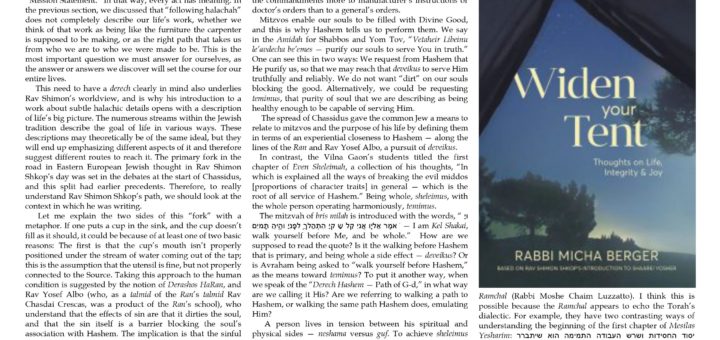
Rabbi Rich Wolpoe posted to the Nishma blog an exchange we had by email. Here are some snippets of things I say in the post and consequent dialog (so far):

Look how similar TIDE [Torah im Derech Eretz] and Slabodka are in terms of objective. …

There is a fundamental difference in how they define refinement. R’ Hirsch speaks in terms of culture. Slabodka, unsurprisingly, in terms of middos. The overlap is large, but they are far from identical. I think that also underlies their difference in approach to ta’amei hamitzvos [the reasons for, or lessons taken from, mitzvos -micha].

RSRH makes it about internalizing messages. And therefore when the message is unclear, he invokes symbology. Symbols do present messages in a manner where they can be better internalized. Thus the power of poetry over prose. …

Mussar looks to mitzvos to behaviorally change the person. …

Middos aren’t really emotions as much as the various propensities to have one or the other. In English, the difference between the emotion of anger and the character trait of having a temper.

Slabodka (as the rest of Mussar, but Slabodka IMHO is closest to TiDE) is speaking of mitzvos in terms of precognitive changes, of being the kind of person more likely to experience religious ecstasy, not necessarily creating that moment of ecstasy itself.

RSRH’s symbology system presumes changes through internalization of symbols — and yet very little Torah existed before his day explicating those symbols….

Because the post is on Nishma, I shut off comments to this post. Instead, kindly add to the discussion there.

Links:

The Problem

In early May, Johanna Justin-Jinich, a student at Wesleyan University, was shot to death at an off-campus book store. Her killer was in the middle of reading the Protocols of the Elders of Zion, and mentioned the victim’s Jewishness as part of the cause for killing her. Court records report that his journal entry the day before the killing, read: “Kill Johanna. She must die…. I think it OK to kill Jews and go on a killing spree at this school.”

More famously was the attempted bombing of two synagogues in Riverdale, the Bronx, New York City three weeks back.

Now, an attack at the Holocaust Museum in Washington DC. The killer, a long-time antisemite, finally turned words into violence when the government cut his Social Security check and he blamed the Jews. “Obama was created by Jews” a note on his car windshield read at the time of the killing. Another read, “Jews control the mass media … Jews captured America’s money.” Ironically, Stephen Tyrone Johns Hy”d lost his life protecting the very memory that should have kept us all safer.

Quoting the New York Times:

“The proximity of the Riverdale bomb plots and the U.S. Holocaust Memorial event demonstrates clearly there’s a serious threat against the Jewish community,” the council’s associate executive director, David M. Pollock, said on Thursday.

The economy is doing poorly, Jewish names get thrown around — whether fairly, like Madoff’s, or unfairly, like people thinking Lehman Brothers is still Jewish — and antisemitism is on the rise. Not as in Europe, but still, lives have been lost.

There is a pattern and a clear need to increase protection at Jewish sites in the United States.

One Person’s Proposal

On the other hand, the same bad economy that is creating this uptick in violence makes it difficult to find the means to increase protection. The typical shul can’t raise the funds to hire a security guard. We’re going to have to rely on volunteerism.

I therefore recommend we adopt a neighborhood watch model. Rabbanim need to remind their congregants of the importance of making sure the doors are locked when leaving the building.

When the building is in use, one person, or better, a chavrusah (who can learn together while on duty and therefore not waste the time) be stationed outside the entrance of the synagogue or school and even at the block with the kosher shopping strip. While I don’t know if the risk is severe enough to qualify for the use of radios on Shabbos, we could perhaps ask the Hatzolah members who already have a reason to permissibly carry one to play a role in this effort.

And of course we should make use of whatever police presence our representatives can garner for this purpose.

I invite you to suggest other ideas.

I URGE YOU to raise the issue with the local rabbis, elected official and community leaders.

What’s the relationship between a human’s intuitive sense of what’s moral and halachic mandate? There is a tendency in some circles to describe the Torah as though halakhah was the sum total of the guidelines Hashem gave us for behavior.

This is belied by a number of the mitzvos that require we follow some sense of “right” or “holy” that isn’t spelled out in behavioral terms. That we must know what “good” means beyond doing what is detailed through halachic methodology  in order to obey them. For example “be holy, for I am Holy” which the Ramban famously tells us is an obligation not to be “disgusting with [what would otherwise be] the permission of the Torah”. By definition, the Ramban assumes there is a definition of “disgusting” that isn’t defined by halachic process. Or “and you shall do hayashar vehatov — the upright and the good” . Qedushah, yosher and tov are treated as givens, that a person is expected to know what they are before one can even begin to explore the halachic mandate.

One can accordingly translate HIllel’s famous words to the prospective ger, “That which you would loathe [if in their shoes] don’t do to others. Now go and learn” into “All of the Torah is an elaboration of natural morality. However, you would never figure out how to reach the right conclusions from those principles unless you go study Torah.”

It’s like saying that all of biology is inherent in Physics. Even that said, you would never be able to derive biology on your own. If we were to rely on our ability to build the system outselves from the first principles we would quickly exceed human capacity; errors would necessarily be made That’s the role of halakhah, to allow us to work with notions closer to our question than the basic moral principle from which they derive.

Along similar lines is the mitzvah of “vehalakhta bidrakhav — and you shall go in My Ways”, which our sages elaborate (this version is from the Rambam, Hilkhos Dei’os 1:6) “Just as He is called ‘goodwilled’ (חנון), so too you must be goodwilled; just as He is called Merciful, so too you must be Merciful…” Hilkhos Dei’os, Chovos haLvavos — entire texts based on the notion that one must be a moral being.

The Rambam writes:

Moses prayed to God to grant him knowledge of His attributes, and also pardon for His people; when the latter had been granted, he continued to pray for the knowledge of God’s essence in the words, “Show me thy glory” ([Exod. xxxiii.] 18), and then received, respecting his first request, “Show me thy way,” the following favourable reply, “I will make all my goodness to pass before thee” (ib. 19); as regards the second request, however, he was told, “Thou canst not see my face” (ib. 20). The words “all my goodness” imply that God promised to show him the whole creation, concerning which it has been stated, “And God saw everything that he had made, and, behold, it was very good” (Gen. i. 31); when I say “to show him the whole creation,” I mean to imply that God promised to make him comprehend the nature of all things, their relation to each other, and the way they are governed by God both in reference to the universe as a whole and to each creature in particular. This knowledge is referred to when we are told of Moses,” he is firmly established in all mine house” (Num. xii. 7); that is, “his knowledge of all the creatures in My universe is correct and firmly established”; for false opinions are not firmly established. Consequently the knowledge of the works of God is the knowledge of His attributes, by which He can be known. The fact that God promised Moses to give him a knowledge of His works, may be inferred from the circumstance that God taught him such attributes as refer exclusively to His works, viz., “merciful and gracious, longsuffering and abundant in goodness,” etc., (Exod. xxxiv.  6). It is therefore clear that the ways which Moses wished to know, and which God taught him, are the actions emanating from God. Our Sages call them middoth (qualities), and speak of the thirteen middoth of God (Talm. B. Rosh ha-shanah, p. 17b)…Moshe’s ability to be the conduit for the Torah and the fountainhead for the halachic process was his being shown the morality inherent in how G-d made and runs the world.

- Guide to the Perplexed I:54 (Freidlander translation)

The revalation of Hashem’s attributes was fulfilled in showing Moshe how He runs the universe. That revalation gave Moshe the ability to “walk in His ways”. But more than that, the Rambam writes later in that chapter:

By the mention of this attribute we are, as it were, told that His commandments, undoubtedly in harmony with His acts, include the death even of the little children of idolaters because of the sin of their fathers and grandfathers. This principle we find frequently applied in the Law, as, e.g., we read concerning the city that has been led astray to idolatry, “destroy it utterly, and all that is therein” (Deut. xiii. 15). All this has been ordained in order that every vestige of that which would lead to great injury should he blotted out, as we have explained.

As the Torah states

וַיֹּ֣אמֶר ה֔’ הִנֵּ֥ה מָק֖וֹם אִתִּ֑י וְנִצַּבְתָּ֖ עַל־הַצּֽוּר׃ וְהָיָה֙ בַּֽעֲבֹ֣ר כְּבֹדִ֔י וְשַׂמְתִּ֖יךָ בְּנִקְרַ֣ת הַצּ֑וּר וְשַׂכֹּתִ֥י כַפִּ֛י עָלֶ֖יךָ עַד־עָבְרִֽי׃ וַהֲסִֽרֹתִי֙ אֶת־כַּפִּ֔י וְרָאִ֖יתָ אֶת־אֲחֹרָ֑י וּפָנַ֖י לֹ֥א יֵֽרָאֽוּ׃
וַיֹּ֤אמֶר ה֙’ אֶל־מֹשֶׁ֔ה פְּסָל־לְךָ֛ שְׁנֵֽי־לֻחֹ֥ת אֲבָנִ֖ים כָּרִֽאשֹׁנִ֑ים וְכָֽתַבְתִּי֙ עַל־הַלֻּחֹ֔ת אֶ֨ת־הַדְּבָרִ֔ים אֲשֶׁ֥ר הָי֛וּ עַל־הַלֻּחֹ֥ת הָרִֽאשֹׁנִ֖ים אֲשֶׁ֥ר שִׁבַּֽרְתָּ׃

Hashem said: Here, there is a place with Me, and you shall stand on the boulder. When I pass my Glory by, I will place you in a cleft in the boulder and I will remove My “Palm” and you will see My “Back”, but My “Face” will not be seen.

Hashem said to Moshe: Carve for yourself two stone tablets like the first ones, and I will write on the tables the ideas which were on the first tablets which you shattered.

– Shemos 33:21-34:1

Natuaral moral law is expressed in halakhah. The connection is not self-evident, and in fact requires Divine Intellect to accurately get from “that which you loathe…” to the laws of making tea on Shabbos. But Hillel, the Ramban and the Rambam all tell us that our intuitive notion of right is in line with the principles of halakhah. It is from seeing Hashem’s creation that Moshe was prepared to carve the second luchos. And thus, where not contradicted by those non-obvious cases, we are required to follow natural morality. That’s qedushah, tov and yosher.

From the Ramchal’s introduction to Mesilas Yesharim (tr. R’ Aryeh Kaplan):

This is what Moses our Teacher, may Peace be upon him, teaches us in saying:

יב וְעַתָּה֙ יִשְׂרָאֵ֔ל מָ֚ה יְ-הוָ֣ה אֱ-לֹהֶ֔יךָ שֹׁאֵ֖ל מֵֽעִמָּ֑ךְ כִּ֣י אִם־לְ֠יִרְאָה אֶת־יְ-הוָ֨ה אֱ-לֹהֶ֜יךָ לָלֶ֤כֶת בְּכָל־דְּרָכָיו֙ וּלְאַֽהֲבָ֣ה אֹת֔וֹ וְלַֽעֲבֹד֙ אֶת־יְ-הוָ֣ה אֱ-לֹהֶ֔יךָ בְּכָל־לְבָֽבְךָ֖ וּבְכָל־נַפְשֶֽׁךָ׃ יג לִשְׁמֹ֞ר אֶת־מִצְו֤͏ֹת יְ-הוָה֙ וְאֶת־חֻקֹּתָ֔יו…

And now, Israel, what does Hashem your G-d ask of you, but that you fear / be in awe of Hashem your G-d to walk in all His ways, and to love Him and serve the Lord your God with all your heart and all your soul. To observe the mitzvoth of God and His statutes…

- Devarim 10:12-13

Herein have been included all of the features of perfection of Divine service that are appropriate in relation to the Holy One blessed be He. They are:

  1. היראה – fear/awe of G-d,
  2. ההליכה בדרכיו – walking in His ways,
  3. האהבה – love,
  4. שלמות הלב – wholeheartedness, and
  5. שמירת כל המצוות – observance of all of the mitzvoth.

“היראה – Fear/awe of G-d” denotes fear of the Majesty of the Blessed One, fearing / being in awe of Him as one would a great and mighty king, and being ashamed at one’s every movement in consequence of His greatness, especially when speaking before Him in prayer or engaging in the study of His Torah.

“ההליכה בדרכיו – Walking in His ways” embodies the whole area of cultivation and correction of character traits. As our Sages of blessed memory have explained, “אבא] שאול אומר: ‘ואנוהו’ הוי דומה לו] מה הוא [חנון] ורחום אף אתה היה [חנון ו]רחום – [Abba Shaul says: 'And I shall glorify Him - ואנוהו - be similar to Him.] Just as He is [giving and] merciful, be also [giving and] merciful…” (Shabbos 133b) The essence of all this is that a person conform all of his traits and all the varieties of his actions to what is just and ethical. Chazal have thus summarized the idea:

[רבי אומר: איזו היא דרך ישרה שיבור לו האדם?] כל שהיא תפארת לעושיה, ותפארת לו מן האדם…

[Rebbe says: What is the "straight path" that a person should traverse?] All that is praiseworthy in its doer and brings praise to him from others…

- Avos 1:2

that is, all that leads to the end of true good, namely, strengthening of Torah and furthering of brotherliness.

“האהבה – Love” – that there be implanted in a person’s heart a love for the Blessed One which will arouse his soul to do what is pleasing before Him, just as his heart is aroused to give pleasure to his father and mother. He will be grieved if he or others are lacking in this; he will be jealous for it and he will rejoice greatly in fulfilling aught of it.

“שלמות הלב – Whole-heartedness” – that service before the Blessed One be characterized by purity of motive, that its end be His service alone and nothing else. Included in this is that one’s heart be complete in Divine service, that his interests not be divided or his observance mechanical, but that his whole heart be devoted to it.

“שמירת כל המצוות – Observance of all the mitzvos,” as the words imply, is observance of the whole body of mitzvos with all of their fine points and conditions.

The Ramchal clearly denies the idea that observing halakhah is the entirety of following the Torah.

If we look at the other four elements, we see the two emotions central to our relationship with Hashem, יראה and אהבה. We also see two aspects of perfecting one’s middos: emulating Hashem, and being whole. The Ramchal lists them as two pairs: an emotional element and a behavioral one in each. A dialectic.

On the one side — יראה, the fear/awe of G-d, an awareness of His magnitude and the consequent “walking in His ways”. To know that He is Great would naturally generate a desire to follow His example and thereby also reach for greatness.

One the other side is אהבה, love of G-d and wholehearted service. Not walking the path G-d shows us by example, us walking with Him, but walking the path to Him. Such is love.

It is only through that יראה and emulation, אהבה and wholehearted dedication, that one can truly observe Hashem’s mitzvos in a manner that is “what Hashem asks of us”. Halakhah then becomes the synthesis of these goals, the means to know when to operate
on the plane of awe-imitation or on the plane of love-following, to have something greater than either.

A long while back I wrote some thoughts on the dispute between the Ramban and the Rambam about what makes Hebrew the holy language, in the context of a general dispute over the context of qedushah. The Rambam says that Hebrew’s holiness comes from it having no native expletives, even sexual organs are identified by euphemisms or loan words. The Ramban, just as he defines “and you shall be holy” as going beyond the letter of the law, defines the sanctity of the Hebrew language in terms of its relationship to G-dliness — not “merely” that it toes the halachic line.

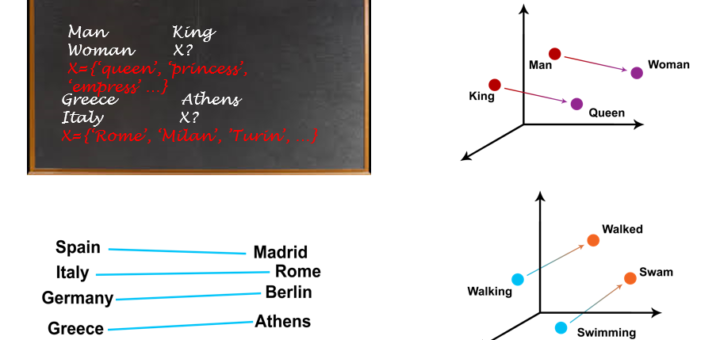
Along the lines of the Ramban, I want to explore the relationship between language and thought. Your mind is less capable of managing those ideas if you’re thinking in a different lexicon and grammar. Knowing the assumptions behind the language is actually a precondition for correctly understanding the worldview! This is my justification for spending time looking at verb tenses and parts of speech in the Hebrew of the Tanakh,  or the implication of the hononimity of “tov meaning both “functionally good” (it does its job well) and “morally good” (such as a good person), or the numerous times I start the discussion of a topic with the etymology of the root of the Hebrew term.

To quote 1984 (George Orwell, 1948) the story’s Ingsoc (English Socialist] leaders invented the language of NewsSpeak for this reason:

The purpose of Newspeak was not only to provide a medium of expression for the world-view and mental habits proper to the devotees of Ingsoc, but to make all other modes of thought impossible. It was intended that when Newspeak had been adopted once and for all and Oldspeak forgotten, a heretical thought–that is, a thought diverging from the principles of Ingsoc — should be literally unthinkable, at least as far as thought is dependent on words. Its vocabulary was so constructed as to give exact and often very subtle expression to every meaning that a Party member could properly wish to express, while excluding all other meanings and also the possibility of arriving at them by indirect method. This was done partly by the invention of new words and by stripping such words as remained of unorthodox meanings, and so far as possible of all secondary meanings whatever…A person growing up with Newspeak as his sole language would no more know that ‘equal’ had once had the secondary meaning of “politically equal,” or that ‘free’ had once meant “intellectually free,” than, for instance, a person who had never heard of chess would be aware of the secondary meanings attaching to ‘queen’ or ‘rook.’ There would be many crimes and errors which it would be beyond his power to commit, simply because they were nameless and therefore unimaginable.

This is an informal form of a notion in linguistics called the “Sapir-Whorf Hypothesis”, formulated by Edward Sapir and further developed by his student, Benjamin Lee Whorf. Here is  Sapir’s formulation (The Status of Linguistics as a Science, 1929):

Human beings do not live in the objective world alone, nor alone in the world of social activity as ordinarily understood, but are very much at the mercy of the particular language which has become the
medium of expression in their society. It is quite an illusion to imagine that one adjusts to reality essentially without the use of language and that language is merely an incidental means of solving specific problems of communication or reflection: The fact of the matter is that the ‘real world’ is to a large extent unconsciously built up on the language habits of the group. No two languages are ever sufficiently similar to be considered as representing the same social reality. The worlds in which different societies live are distinct worlds, not merely the same world with different labels attached… Even comparatively simple acts of perception are very much more at the mercy of the social patterns called words than we might suppose…We see and hear and otherwise experience very largely as we do because the language habits of our community predispose certain choices of interpretation.

And Whorf writes in “Science and Linguistics” (1956 edition):

We dissect nature along lines laid down by our native languages. The categories and types that we isolate from the world of phenomena we do not find there because they stare every observer in the face; on the contrary, the world is presented in a kaleidoscopic flux of impressions which has to be organized by our minds — and this means largely by the linguistic systems in our minds. We cut nature up, organize it into concepts, and ascribe significances as we do, largely because we are parties to an agreement to organize it in this way — an agreement that holds throughout our speech community and is codified in the patterns of our language. The agreement is, of course, an implicit and unstated one, but its terms are absolutely obligatory; we cannot talk at all except by subscribing to the organization and classification of data which the agreement decrees.

Similarly (but lehavdil!), the language the Torah was given in and which was shaped by a community that followed it will make it easier to think along the same lines.

Not my usual speed for a blog entry, but I saw this and was nispael (awed). It’s a video of what does on within a cell. How much Divine Wisdom there is in just one microscopic little spot within the world, and how easy it is to take for granted!

(If you do not see a video below this sentence, try this link.)

My current employer is meticulous about hanging mezuzos. He hired a rav who is an expert in this particular mitzvah, and he went around identifying every doorway. (Some of which are non-obvious, like where the metal between the tiles in the ceiling makes the top of the “door-frame”.)

On the way down the hall, I did a double-take. There was the alarmed emergency door, with the mezuzah on the left and angled the wrong way. It was as though the rabbi decided that unlike every other doorway from the hall, this one ran in the other direction — into the hall rather than outward from it. It actually took me over a day before I realized why — from the outside, this door is the entrance to the hall. You enter through the lobby, up the stairs and through the emergency door and into the hall. Whereas the other doors are from the hall to a particular destination.

And it took me another day to realize the basic mussar point, why the mezuzah’s placement was non-obvious to me.

When I think of an emergency, I’m thinking of how I would escape. How the door would get me out of the hall in case of a fire. However, if there were a fire on one of the higher floors, the door would be used to let them escape to a lower level. There is a self-centerdness, at least when thinking of survival, that kept me from thinking of the doorway objectively, as being a way in in addition to being a way out.

At this point we’re so far mid-stream, that unlike the previous post, I’m not going to summarize the basic thesis or even pretend to try to translate terms already used. Instead, I will just point out the conclusions so far with respect to birur from just the last two posts (parts 2 and 3). Then we’ll discuss the concept of “chazaqah” and conclude with an observation of how these rules of birur interplay.

There are two sorts of logic used:

Qavu’ah logic: the reality was once experienced, so the halakhah was once established, but now unknown. This includes cases of qavu’ah, eidus and hapeh she’asar, so far. The doubt remains a doubt, and therefore is ruled stringently if in Torahitic law, and leniently in rabbinic law.

Parish logic: the scientific reality is within the realm of human experience, but never actually was experienced. Therefore, people relate to the item in terms of personal doubt. It’s the doubt that becomes the topic that we decide halakhah upon. Rov isn’t what is more probable as treated in a mathematical, statistical, way. It’s not estimates about scientific reality, it’s mental attitude. And since people do think in terms of “maybe” and probably — including the possibility of believing contradictory maybes or probabilities at once — in these cases majority is considered.

Chazaqah

In normal situations of testimony, the words of a witness (or, via migo, those of a litigant), by establishing that the reality was observed, put us in the realm of qavu’ah as opposed to that of parish. Once testimony is accepted, rules for resolving a safeiq by allowing certain assumptions about the underlying situation (e.g. rov) become irrelevant.

One class of rules of birur, doubt resolution, is chazaqah. There are two subcategories of chazaqah (the following terminology is that of the Revucha diShmaatsa on the Shev Shma’atsa cited below):

1- The first is chazaqah dimei’ikara, where we assume that things remain the way they were last perceived until someone experiences otherwise. For example, a chalaf (knife used for shechitah) is supposed to be checked before each shechitah), but if it wasn’t the meat is still kosher. The knife has a chazaqah of being kosher since the last time it was checked. If the knife is lost and can’t be checked, the meat is kosher.

1b- If the knife is checked, and is found to be flawed, then the chazaqah is called a chazaqah de’ikka rei’usa (a chazaqah where there exists a flaw). Which in general would still have some significance (Shev Shmaat’sa 1:7,8). However, here it is trumped by the chazqah the meat holds, that before it was slaughtered it wasn’t kosher. (Rambam Hil’ Shechitah 1:24, Shulchan Aruch YD 18:11)

2- The second kind of chazaqah is the chazaqah disvara. These are rules of nature or human nature that we can presume were obeyed. An example is “ein adam chotei velo lo”, a person won’t sin unless he’s trying to personally benefit from it.

I think these two kinds of chazaqah actually operate on two different levels.

According to the Shev Shma’atsa (6:22), of the two, only chazaqah dimei’ikara has authority in the face of two conflicting sets of eidim. Meaning that if two witnesses testify for the prosecution and two testify for the defense, but an initial state was once known, we still assume the items involved are in their initial state.

Chazaqah disvara, the Shev Shma’atsa continues, adds no credibility to that side’s argument beyond the other. If the defense not only has witnesses, but his side of the case is also supported by a lack of motive (as we said “ein adam chotei velo lo“), it is still considered by the court to still remain a balanced dispute.

Why the difference?

A chazaqah dimei’ikarah is a situation where reality has been experienced. The chazaqah tells us not to reopen the doubt. It therefore operates in the same domain as qavu’ah and as testimony. If halakhah must address the world as experienced, this is how people last experienced the world.

It’s like leaving a room in which someone is sitting in a chair reading. When you come back 8 hours later, you see the person in the same chair with the same book. Our natural assumption is that the person is still reading. It is possible, though, that they got up and only returned shortly before we did — but it’s not natural to consider that possibility; it’s at best a second reaction. We relate to objects given their last known state, and assume no change until we have reason to believe otherwise. That is the reality, the world-as-experienced, and thus halakhah is determined on the same level as the conflicting witnesses.

A chazaqah disvarah is much like rov. A rule of thumb tells us which possibility is the more likely — when in doubt, assuming things went as they usually do. Chazaqah is even stronger than that, giving us the power to assume things went according to the norm, and we needn’t even consider that this might be the exceptional case.  But still, it’s parish logic.

Once we have eidim, though, we can’t look at the situation in terms of the various alternatives. One and only one of them was experienced by whichever eidim are being honest, and therefore a halakhah for that specific case already exists. Chazaqah disvara resolves the wrong kind of doubt for this situation, and therefore adds nothing to the argument.

But beyond establishing that a chazaqah disvara is a kind of super-rov, and using that to explain the Shev Shmaatsa’s distinction, I don’t have much to say about it. So in the next section of this post, we will only be discussing the chazaqah demei’ikara, and therefore I will follow the usual convention of not using an adjective to distinguish the two.

Interaction of Rules

The mishnah on Qiddushin 64 discusses the case of a dying man r”l who says he has children. Abayei adds to the case (because of a contrast to a halakhah in a related beraisa) that we didn’t know anything about his having children. Therefore after his death, she stands in a chazaqah of not being a yevamah — she obviously wasn’t one before he died!

The man stood to gain nothing from his claim. This is a case of “mah li leshaqeir” (”what do I gain by lying?”) which is similar enough to migo to be considered a subtype by numerous rishonim ad loc. Credibility is given to the claimant again because assuming he is lying would make his action irrational. Here it’s a different reason then the existence of a better lie (migo) but the point is the same.

So, permitting her to remarry is supported by a chazaqah, but prohibiting her is a migo (or a migo-like structure).
The man is believed. The conclusion of the gemara is that a migo “trumps” a chazaqah.

This fits nicely within the model we have been developing. The presumption of the chazaqah dimei’ikara is only a chazaqah, a presumption, and can only apply in the absence of a new, credible po’al experience. It tells us to continue with what was last perceived about the reality.  Migo established a new observation; the claimant establishes a new perception, and thus a new halakhah.

Notice, this means something very unexpected.

1- We just said that given a chazaqah supporting one side’s position, and a migo supporting the other, the migo has the stronger claim.

2- In the previous section we saw that migo in the context of conflicting testimonies has no weight (as we said earlier, this is because we don’t compare quantities of testimony);

and yet:

3- chazaqah in the case of conflicting testimonies does factor in.

To highlight the oddity, note that cases (2) and (3) imply that:

3b- If the chazaqah and the migo conflicted in the situation where contradictory testimonies were also presented (trei utrei), the migo would be ignored, the chazaqah would not. Unlike case (1), the same situation in the absence of trei utrei, where migo would have priority over chazaqah!

This non-intuitive conclusion can also be explained using our model for qavu’ah logic. The two rules differ on the time of the reality that is established.

In the case of a chazaqah, we are establishing a halakhah based on the perception at an earlier point in time than the moment in question. When we have no later perception, we have to carry that reality forward in time. People naturally assume the world didn’t change — only until they learn otherwise.

The witnesses are in conflict about the reality at the time in question. Migo as well is about the present, not the past. Therefore all of these carry more evidentiary weight than a chazaqah from the past.

On a given question of qavu’ah, where we know something was perceived but we don’t know what, we said that quantity doesn’t matter. Therefore, with the migo added into the balance of eidim, it’s like more eidim added to the balance — the sides are still considered equally. (Again: This is the notion that once halakhah is established, we don’t play “Russian Roulette” with minority chances of violating it. It is only in considering the perception of a reality that we allow the fuzziness of doubt be the reality, and thus consider which is more likely as a factor.)

And so, revisting this odd triangle with rationals:

1- Migo usually has a stronger claim than chazaqah because it’s about a perception of reality closer to the time in question.

2- But it has no weight once the question of that later reality was rendered unresolvable by a dispute over what it was.

3- In which case, we can still fall back on the earlier perception, chazaqah.

Conclusion

And all of this halachic discourse of the past three posts was grounded on the idea that we resolve doubt in reality psychologically, including thinking “it probably was…”, whereas we do not in doubt in something that was attested to — either subsequently lost in a mixture (qavu’ah), time went by and something might have changed (chazaqah demei’kara), or we don’t know which person really accurately is reporting their perception (conflicting testimony or the claimant is a litigant but migo or hapeh she’asar gives him some credibility).

Because we base halakhah on how it will cause people to react, not on unexperiencable objective realities that will do little to help a person ascend the Mountain of G-d.

Someone raised on Avodah the following question (see the posts listed here under two different subject lines, “Kinyan on Shabbos??” and “Kinyan on Shabbos? (Har Sinai)” ). The first Shavuos was on a Shabbos. Didn’t we acquire the Torah — doesn’t this imply a qinyan on Shabbos — which is prohibited? What about our being made avadim, servants, of the Almighty? And the event is compared to a wedding, which we don’t perform on Shabbos.

I answered on-list on a technical level — a qinyan is allowed on Shabbos if it’s for the sake of a mitzvah or according to others for the sake of Shabbos. And what could be more for the sake of Shabbos than giving us the covenant that includes Shabbos? (It was previously commanded at Marah, but it’s the version given at Horeb that is binding today.) The Rama famously performed a wedding that was scheduled for Friday but ran late into Shabbos. (There were extreme circumstances, but still, he permitted it.) Etc…

However, I think there is a meta-issue that is more significant to discuss, and therefore I’m elaborating on the Avodah post where I raised that issue here.

The comparison of matan Torah to a qinyan, a wedding or avdus isn’t necessarily halachic. It is more reasonable to think it’s on an aggadic level, and this whole question doesn’t really begin.

Also, given my attitude toward the historical accuracy of aggadita, I wouldn’t assume that placing Matan Torah on Shabbos is a historical claim. Nor would I assume it isn’t. The point is to provide a, not a study of history. History and legend were blindly mixed because the question is just off topic to talmud Torah.

This is actually easier to support mesoretically than assuming that these narratives were intended as historical assertions (in addition to their metaphor). See R’ Daniel Eidensohn’s “Da’as Torah”. Despite what is presented as the “frum” answer today, this is the position of R’ Saadia Gaon, the Rambam, his son R’ Avraham, the Maharsha, the Maharal, the Vilna Gaon, R’ Hirsch, R’ Yisrael Salanter, etc… Because someone might be surprised that this is the actual normative traditional attitude toward aggadita, I’ll give two sources that I already had on-hand.

The first I posted recently. With respect to aggadic stories, the Rambam (introduction to his commentary to chapter Cheileq in Sanhedrin, a little before his list of the 13 articles of faith, identifies three categories of people, two wrong camps, and one right one. The erroneous approaches are: (1) Those who take all the fantastical claims of the stories as literal, find them absurd, and ridicule the Torah for it; and (2) Those who take them as literal, take them seriously, and therefore believe in an absurd distortion of the Torah. The correct approach is (3) to realize that the Torah convey deeper truths via hint and riddle. (Which he laments is a class of students of the Torah that is small and far between, a class in the sense that “the sun is in the class of all suns.)

And from Rav Yisrael Salanter:

We are living now in the period following the German conquest of several districts of France. The German Kaiser has now become the mighty sovereign of many isolated provinces, which he has united into one mighty state. In order to immortalize its victory, the German government changed the appearance of the eagle in its national emblem, making it two-headed instead of one-headed (as it was until now). Historians, writers and poets praise the conquest with exaggerated descriptions. I myself have read the lines, “The German eagle has spread its wings from Memel to Metz. One of its claws grips Koeln, while the other is in Baden.” Instead of detailed and realistic descriptions of international wars, what they record for posterity are symbols and hints that are only well understood by the generation in which the events occurred.

With the changes of time, memory of the events will fade, and all that will remain will be the terse symbolic account. A long time from now, people will read that in German a two-headed eagle spread its wings for 500 miles. Perhaps they will laugh at this, just as they laugh at [the stories in] the aggada.

The same thing happened to us. Chazal used terse symbolic language to describe the events of and before their time, and they recorded the Torah’s wisdom and mussar in epigrams. These sayings were only understood by the people of their generations, and by mequbalim of later generations.

The notion that the forefathers observed the entire Torah, even Rabbinic rulings, is also an aggadic story, and is no more likely or not to be historical. But it’s not even made about the generation in question.

ALL THAT SAID, it seems to be the rules of aggadic stories, even the ones that aren’t historical, that they do not have any of the “good guys” doing something we wouldn’t. And so we still find commentaries trying to justify things on a halachic basis. This shouldn’t be taken to mean they assumed the events actually occurred!

Which was the thing I was trying to do here. I don’t think there is any reason to believe there actually was a qinyan of any sort done on Shabbos as part of Matan Torah. Still, because Chazal use that metaphoric language, it must be able to work halachically — or else they would have chosen different metaphors.

I’m curious to know how many of us who believe we’re supposed to want a restoration of the sacrifices actually anticipate it. I must confess that I’m too 21st cent for that, and generally during Mussaf or Qorbanos (or parts of the liturgy that discuss sacrifices) my thought is asking G-d to help me learn how to want them, to realize what I’m missing on an emotional level.

On an intellectual level, I think of it in terms of a parallel to buying my wife flowers. She doesn’t need the flowers. Most of the time, she never even looks at the flowers, and doesn’t even notice them at the Shabbos table except when they get in the way of seeing someone. (Of course, other wives could well appreciate their beauty more, but I think the next point still stands.)

Giving my wife flowers isn’t about the flowers, but about the giving. Human beings in a relationship have a need to give. And we feel more appreciated and loved when we see someone make the effort to give. While we all like our toys, and it’s not only the thought that counts (in real, non-idealized people), the thought is much of the gift.

We also like to share meals with those we love. There is something very primal about “breaking bread together”.

Look how the Torah describes sacrifices. They aren’t first commanded. Qayin and Hevel naturally come up with them. Noach is overcome by gratitude (and perhaps a hefty load of survivor guilt, which would explain his desire to lose himself in wine) and makes an offering, etc… The laws of qorbanos don’t come with a claim that they are the invention the notion of offering something to G-d. Rather, they channel and embellish a natural inclination.

If we were feeling an equally deep emotional attachment to G-d, we would also feel this need to give. Not only meaningful gifts, but also gestures as gestures. It is only when the gesture is used instead of the meaningful gift, when we offered sacrifices in an attempt to keep G-d happy while we took advantage of the poor, the widow and the orphan, that G-d put an end to them. A bunch of roses won’t wallpaper over having an affair. Instead it would increase a wife’s anger at her husband’s transparent attempt to manipulate her. Is this not the metaphor of Hoshea who is told to marry a prostitute (either in reality or within the prophetic vision)  “‘כִּי-זָנֹה תִזְנֶה הָאָרֶץ, מֵאַחֲרֵי ה — because the land is prostituting itself from after G-d.” (Hoshea 1:2)  As Hashem tells Yeshaiah, “לֹא תוֹסִיפוּ, הָבִיא מִנְחַת-שָׁוְא–קְטֹרֶת תּוֹעֵבָה הִיא, לִי; חֹדֶשׁ וְשַׁבָּת קְרֹא מִקְרָא, לֹא-אוּכַל אָוֶן וַעֲצָרָה. — Do not conitnue to bring me empty bread-offerings, incense of disgust it is do Me, the new month, Shabbos and the calling of the holidays — I can no longer stand it alongside the sin and iniquity!” (Yeshaiah 1:13)

For the Torah to tell us to curtail that need to make gestures of affection, to give gifts just for the sake of giving and to share a meal (as much as possible) would be to force an artificiality and lack of authenticity on the notion of loving G-d. Instead, Vayiqra layers more meaning atop the basic primal notion.

As I said at the top, standing here after two millenia of exile, I no longer feel driven by a need to give to Him. There is something incomplete in my ahavas Hashem, love of G-d. I thank him though that He brought me to the point that I at least feel sad over that incompletion.